Design leaders are having to adjust to a new pace that the business now sets. Screens come out finished in minutes, and the quality bar many stakeholders accept is worrying. Even so, deciding what is worth shipping still belongs to the designer. Deeploy Circle was a closed-door evening where Product and Design leaders got together to talk about exactly this, with no stage and no keynote.
Over the past few weeks I read articles, reports and posts, and watched talks from people in very different places, all trying to answer the same question. This piece is what I took away from them. First I look at the hiring numbers and what explains the drop. Then I look at the work and the roles that are emerging for design.
The number that made noise
On November 10, Lenny Rachitsky published his report on the tech job market at the end of 2026. The figure that got shared the most was the one for Product Design: around 1,900 open roles at tech companies worldwide. That is the lowest since he started tracking, and 28% below last year.
Hiring tells the same story. In the US, companies hired 27,600 Product Designers in 2022 and 12,600 in the last 12 months. That is less than half, and the number has fallen every single year since 2022.
The ratio to PMs has shifted too. In early 2023 there were 1.9 PM openings for every design opening. By early 2026 it was 2.6. Today it is 3.8.
The role hit hardest was UX Research: about 1,800 US hires in the last 12 months versus 5,300 in 2022, a 66% drop. There are only 108 open roles worldwide right now. Lenny's read is that faster development leaves less room for design and research. He also points to tools like Listen Labs and Simile, which let non-researchers run studies. He sees speed and new tooling as the cause, and expects things to turn around.
The fear inside the design community
The piece that captured this best was by Pedro Belleza on UX Collective Brasil. Pedro is a UX Design Manager and co-founder of UXConf BR. He describes a company that dissolved its design teams and handed the work to PMs using AI. Quality dropped, and the company still decided the result was good enough. His conclusion: AI doesn't need to be as good as an experienced designer. It only needs the company to find the output acceptable, and the person who decides what is acceptable is almost never the designer.
Pedro also names an old imbalance. Design took part, researched and recommended, but when there was disagreement it rarely had the final say. With AI, a PM can now explore solutions, prototype and build an interface. When a designer does product work, they still report to someone. When a PM does design work, the company starts asking how many designers it really needs.
Figma reached a similar conclusion in its 2026 AI Report, based on 8,403 survey responses and 639 interviews: the lines between designer, developer and PM are blurring.
Some people who responded to Pedro read the shift differently. Rodrigo Lemes, from the DesignTeam channel, argues that product, engineering and design are no longer job titles but disciplines. Engineers design, designers make product calls, and in his view that is already happening.
Tom Scott, who recruits designers through Verified, commented on Lenny's report and said part of the drop comes from a change in job titles. Startups are hiring "Design Engineers" who are, in practice, Product Designers with strong technical chops. Some call the role "Product Builder". As he puts it, there is a seat for everyone, it just might not be called Product Design anymore.
Pedro also reminds us that part of the drop comes from the market correction that started in 2022, driven by higher interest rates, before generative AI carried any real weight. That was the thread I followed in the rest of my reading.
Another angle, with numbers
Inna Tsirlin, PhD and Head of UX Research at YouTube Shopping, redid the math in a LinkedIn post. She noticed that Lenny's chart starts at the peak of post-COVID hiring, so all it can show is the decline. Using Indeed data from Kathryn Brookshier and Bliss Altenhoff, she set Q1 2018 as the 100% baseline.
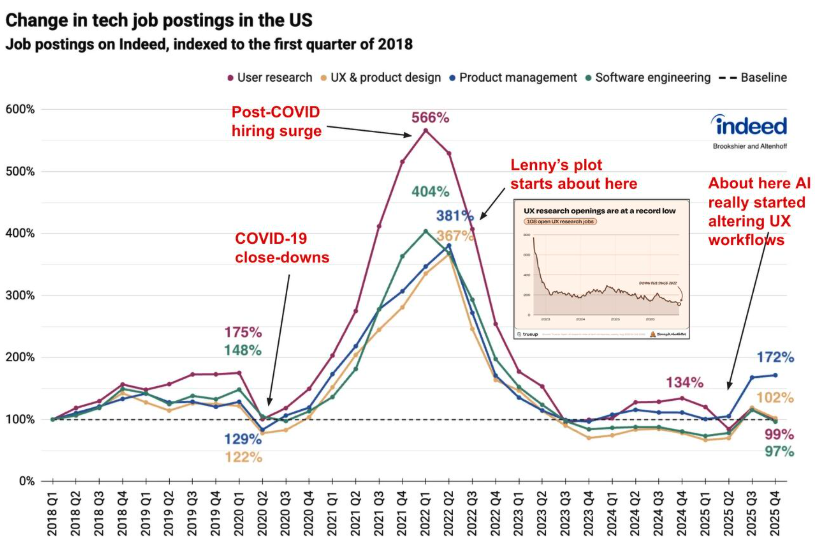
For three of the four roles, late 2025 sits at the same level as 2018. The outlier was the peak, not the fall. Inna believes this is far more likely a post-COVID correction than a serious AI effect. AI only started being used at scale in real workflows in 2025, when the decline was already well underway. It is the same point Pedro made about the correction since 2022, before generative AI mattered. Inna's data shows how big that correction was.
PM is the exception. It is still at 172%, well above 2018, while design is back at 102%. The cycle hit everyone, so it doesn't explain the gap between PM and design. That gap connects to the other half of Pedro's argument. If a PM with AI can explore, prototype and build an interface, it makes sense that companies open more PM roles and start asking how many designers they need.
But that math only counts delivery speed and ignores what happens after a screen goes live. In Pedro's example, quality dropped and the company called it acceptable because no one measured the cost. That cost shows up as usability problems the PM didn't anticipate: a flow that confuses existing users, an error state nobody designed, copy that promises something the product doesn't do. It shows up as rework, when the team has to revisit screens that shipped too fast. And it shows up in support tickets and conversion, when users give up halfway.
The research I cover later shows this cost from other angles. At Workday, about 37% of the time AI saves is lost to fixing, checking and rewriting. Lakhani notes that models drift toward the average, so an interface a PM generates alone tends to be the median answer. Designers step in where AI is weak at deciding: choosing what is worth building, designing the cases nobody asked for, and judging whether the result actually works for the people who will use it. That is why I think it is a mistake to treat AI in a PM's hands as a replacement for design. It speeds up execution, but judging what users will actually experience still needs someone with real design expertise.
One caveat: the Indeed data covers only the US and includes roles across all industries, not just tech. And, as Inna herself notes, it doesn't include the most recent quarters of 2026.
The market cycle
Michelle Schneider, futurist and best-selling author of O Profissional do Futuro (The Professional of the Future), offered an explanation for the same movement at Rio Innovation Week in August 2026: interest rates. Her chart uses LinkedIn and Federal Reserve data from 2019 to 2025 and puts the hiring rate side by side with real interest rates, meaning nominal rates minus inflation.
The two lines cross in the second half of 2022. Before that, hiring was high and real rates were at the bottom. After that, real rates climb and hiring falls through 2025. For Michelle, interest rates explain most of the change in hiring, and AI's impact on jobs is smaller than people think.
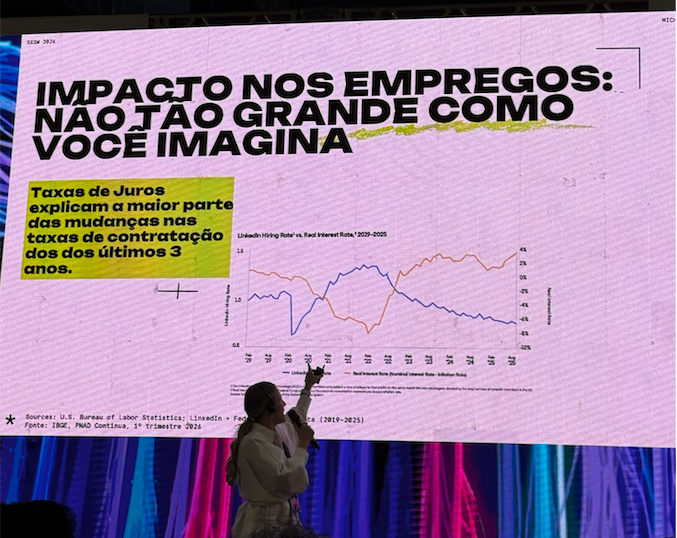
Pedro also cites higher interest rates as one of the causes, and Michelle's chart puts data behind that link. The year the lines cross is the same year Pedro marks as the start of the correction, 2022, when generative AI had no real effect on hiring yet. So his concern and her explanation don't cancel each other out. The volume of jobs fell mostly because of the cycle. Pedro's worry is about what kind of jobs are left.
Design is not going to die
At an earlier event in May 2026 at São Paulo Innovation Week, Michelle drew a parallel she calls the radiologist effect. In 2016, Geoffrey Hinton said we should stop training radiologists because AI would do their job. What actually happened is that AI took over 1 of the 27 tasks in the profession, image recognition. And the number of radiologists has grown about 15% since 2016.
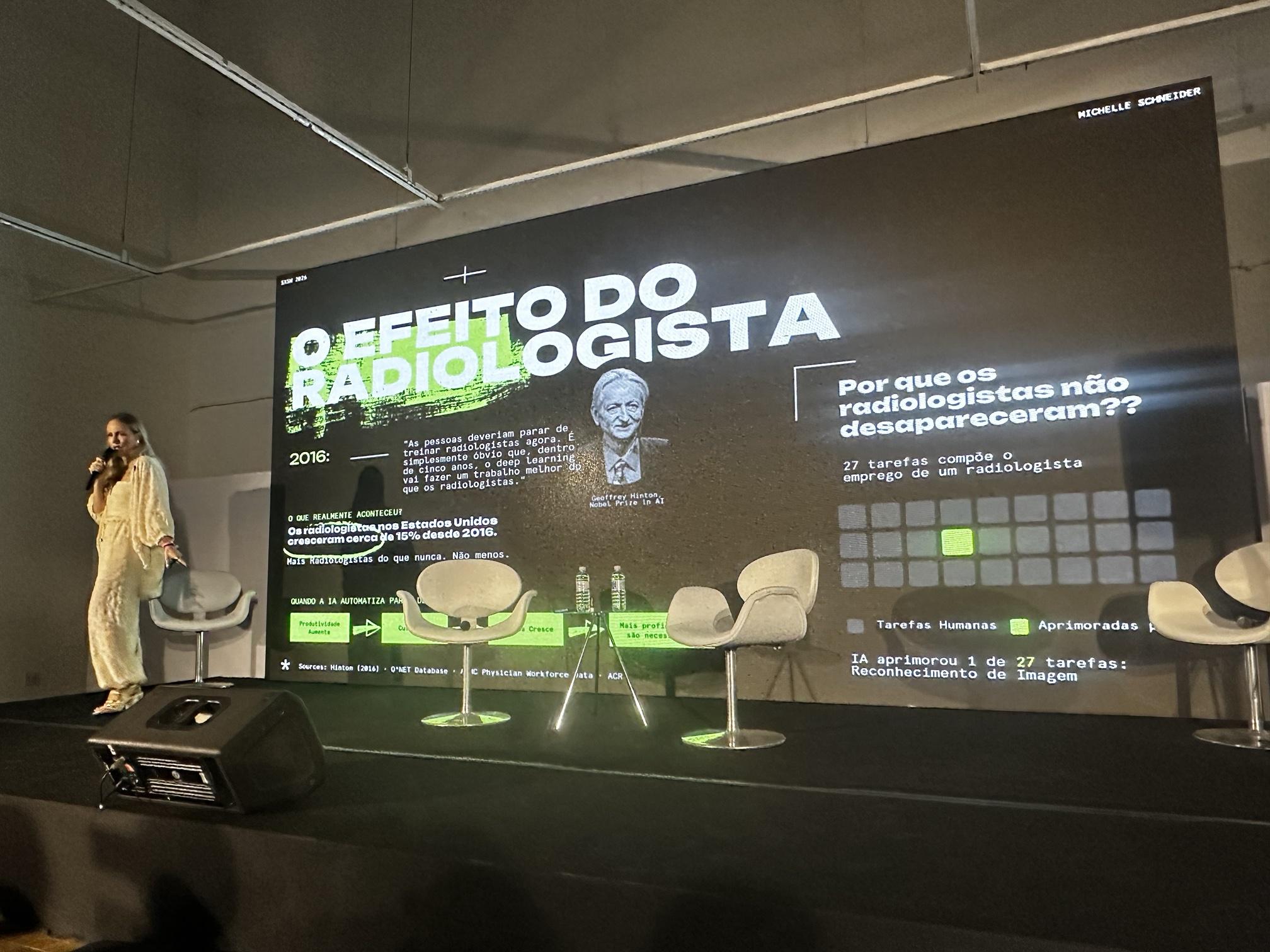
The design column is a hypothesis, not a result. The parallel also has a limit: radiology has regulation and legal liability that design doesn't. So I treat the hypothesis with caution. In design, a company can simply decide the output is good enough, as in Pedro's example.
Design is changing shape
Putting all of this together, I see four things happening at the same time.
- Title. The job title is changing. According to Tom Scott, startups are hiring Design Engineers and Product Builders, who are in practice Product Designers with strong technical skills.
- Cycle. Interest rates and the post-COVID correction move the volume of jobs. AI shapes which jobs remain: more PMs, fewer juniors.
- Tasks. As in radiology, AI takes over part of the work and the profession can carry on.
- Decision. With execution getting cheaper, knowing what is good and what is worth building matters more.
The new kinds of work emerging
Decision-making is the theme that comes up most. Combining what Pedro, Rodrigo Lemes, Tom Scott, Shishir Mehrotra, Karim Lakhani and a thread by Greg Isenberg say, I see nine fronts of work for design.
1. Defining the problem
Shishir Mehrotra is CEO of Superhuman, the company behind Grammarly, and previously led product at YouTube. He describes a career as four steps. At the first, you are handed the problem, the solution and the approach, and you just execute. At the last, you are handed an area and you decide what the right problem is. In his view, AI has given everyone a great set of executors, while knowing which problem to tackle still lives almost entirely in people's heads.
This lines up with what Rodrigo Lemes says about designers who make product decisions. The work that is growing belongs to people who show up before the screen and define what is worth building.
2. Separating certainty from risk
Rodrigo Lemes suggests swapping the usual split between operational and strategic work for one from David Pye, a woodworker who wrote about it in 1968. Work of certainty is work where the outcome is guaranteed because it follows a jig, a template or an assembly line. Work of risk is work where the outcome depends on the maker's judgment.
His example is a sign-up form. Laying out the form is operational. But deciding which fields are required, designing the error state no one asked for, and noticing that the button copy promises something the product doesn't do is judgment. In his view, AI has taken the operational work that required no judgment, like the screen anyone would build the same way or the component the design system already had. Operational work that requires judgment still belongs to the designer.
He proposes an exercise: take what you did yesterday and mark each item as certainty or risk. If anyone with the same tool would have done it the same way, it was certainty.
3. Building, not just designing
Tom Scott talks about Design Engineers and Product Builders. In Y Combinator's Design Review, Marvin Schwaibold, who leads Shopify's product design studio, shows work by designers who code: a shader that recreates real grass, and a tool that exposes design variables. In Lenny's report, Claude became the second most-cited skill in 2026 designer job postings, ahead of CSS, and Cursor overtook CSS as well.
4. Caring about craft
For Tom Scott, when anything can be built, final craft is what sets work apart. He says he is seeing a big rise in demand for Brand Design, Creative Design and Marketing Design. At Shopify, one carousel took 91 iterations before it was done.
Karim Lakhani, professor at Harvard Business School, gets to the same place from another direction. Models drift toward the average, so an engineer working as a team of one can generate something that looks like design but gets the median answer. His question: do you really understand design principles? Do you have taste? Because that is what designers do.
5. Defining how to evaluate what AI produces
Greg Isenberg wrote a thread after a dinner with founders and executives of companies worth between $1B and $100B. Several said they want to hire people with taste who can write evals, the criteria used to judge what AI produces. The reason: models generate so many ideas that the hard part is now deciding which ones are good. In Lenny's report, evals* are already in the top 10 skills requested for PMs.
*Evals are a set of tests and criteria that measure whether an AI product gives accurate, safe and useful answers, before and after it ships. Leaders quoted by Lenny, such as Kevin Weil at OpenAI and Dianne Na Penn at Anthropic, say that evals are the new PRDs.
The same thread describes a vertical AI tool as a set of data connectors, evals written by people who know the work, rules about what the agent is allowed to do, and a simple screen for a person to review. The model itself is maybe 20% of that. The review screen and the criteria are design work.
McKinsey reinforces this in "The judgment bottleneck". One of its recommendations is to require AI to show the data and assumptions it used, so decision-makers know what they are signing off on.
6. Designing for agents and with agents
Isenberg's thread argues that much of the software built around people clicking through lots of screens won't survive the agent era. Some startups barely have an interface because their main user is an agent.
Shishir describes three ways of using AI. The first is talking, the chat. The second is doing, taking tasks off a list. The third is assistance, where the agent comes to wherever the person is working and helps before they ask. That is what Superhuman does with Grammarly, surfacing suggestions as you write. Designing when the agent shows up, what it suggests, and how people accept or dismiss it is a whole new field of interface design.
7. Working with AI, not just hitting play
In a sample of 244 BCG consultants, Lakhani identified three ways of working. Cyborgs (60%) solve the problem together with AI. Centaurs (14%) split the work and supervise. Self-automators (27%) just hit play, and they were the ones who learned the least. Lakhani says he has fired people who said "the AI gave me that", because in the end someone has to put their name on it.
8. Building systems that let PMs, devs and stakeholders generate interfaces with AI
In the AI in Design Report 2026 by Designer Fund and Foundation Capital, which surveyed 906 designers in more than 60 countries, 40% say PMs and engineers are doing more design work.
Design teams have responded by building quality into the tools themselves. They pre-load design system components and brand guidelines into coding tools, so anyone generating an interface starts from the same baseline. The report calls this “designers as systems architects”. Jessica Rosenberg, head of brand at AirOps, uses the term "Agent Captains". The report shares a few examples.
- At Stripe, the team built ProtoDash, a prototyping environment with the design system built in, where anyone can put together a realistic prototype in minutes.
- At Cursor, designer Nick Inzucchi says he can hold the quality bar across everything that gets built, even work that never crosses his desk, because he built the design system into the app itself.
- At AirOps, a brand skill installed in the company's skills library lets everyone create on-brand landing pages, charts and slides.
- At Anthropic, the design team uses a design system picker that loads fonts, colors and components into Claude so prototypes are on-brand from the start. The team also runs a Slack agent that flags off-brand copy in production code.
In its chapter on teams, the report concludes that designers can be the glue that holds together vision, user empathy and the quality bar. They do it by designing the AI workflows that let everyone work within design's rules. This echoes Isenberg's thread, which describes AI tools as rules about what the agent can do and criteria written by people who know the work.
9. Saving research for changes that need a human eye
The same report shows designers shifting where they spend their time. With engineering shipping much faster, they separate projects that need deeper design thinking from features with plenty of precedent. The former are ambiguous UX problems or problems tied to user needs. One leader at a public company put the question this way: how do you tell the ambiguous problems that need UX thinking from the commodity features that don't need differentiation? And 71% of designers say they still trust their own judgment, not AI, to understand user needs and context.
Pedro writes along the same lines. Watching real people in real situations is not the same as a simulation. But he acknowledges that a company can value research without keeping a dedicated team, and Lenny's numbers show UX Research was the role that fell the most.
Putting this information together, my read is that researchers will increasingly be brought in at specific moments, when an interface change touches something AI can't evaluate on its own. A navigation change is a good example. It alters the mental model of existing users, and only by watching real people can you see where they will get lost. For commodity features, ongoing research gives way to what is already known. Anthropic, for example, keeps an index that makes user studies searchable for anyone in the company.
The time AI gives back isn't really spare
All of this new work depends on time to think, and the research shows that time isn't exactly piling up.
Workday surveyed 3,200 people at companies with more than $100 million in revenue. 85% save between one and seven hours a week with AI, but around 37% of that time is lost to fixing, checking and rewriting. Only 14% consistently come out ahead. And 32% of companies turn the time saved into more workload.
In Brazil, a Wellhub study of more than 5,000 professionals across 10 countries found that 37% of the most advanced AI users say their workload went up, versus 13% of beginners. 23% of advanced users have burnout symptoms every day, versus 11% of beginners. Where there is a clear AI policy, 77% feel prepared. Where nobody knows the rules, it is 37%.
McKinsey describes the same problem from the decision-maker's side. In "The judgment bottleneck", a junior team started delivering analyses 10 to 20 times faster, with three to five times more scenarios. Executives took longer to review them because they didn't know which assumptions sat behind the analysis.
Analysis got faster, but judgment stayed at human speed. In McKinsey's State of AI 2026, eight in ten people say AI makes them faster, but only 37% of companies attribute any EBIT impact to AI.
This helps explain Pedro's example. A company can accept a worse screen because it shipped fast, and the cost shows up later in rework, in review time, or in the experience of the people using it.
The question no one has answered
Almost every kind of work I listed depends on judgment. And judgment used to be built by doing exactly the work AI is now taking over.
Rodrigo Lemes addresses this directly. Judgment was formed by doing the routine work, getting it wrong and being corrected. If the machine does that part, where does the next generation's judgment come from? McKinsey points to the same risk: when AI does the analytical work, people starting out lose the practice that would have built their judgment.
The data on entry-level hiring adds weight to that concern.
Karim Lakhani sees people aged 35 to 55, the middle-management layer, as the group most at risk because they are most likely to resist AI. That is his perspective, and not everyone agrees.
Pedro thought UX Research might be more protected, yet in Lenny's report it was the role that fell the most.
Two possible paths come up in these conversations:
- Do it by hand first. Lakhani cites Stephen Wolfram, who says you need to do your first integrals by hand to understand how they work. After that, you learn more by watching the machine do a thousand than by doing eighty more yourself.
- Practice where the stakes are low. Shishir compares it to music and sports: nobody learns an instrument only by playing recitals. For him, judgment is trained on side projects, with friends and fast feedback, far from the meeting where everyone is evaluating you.
If you are not a junior, this question is yours too:
How will you help develop and open doors for people who are just starting out?
What remains open
None of these sources say whether the market will need more or fewer designers. Lenny's numbers point to fewer roles titled Product Designer. In the AI in Design Report 2026, which Pedro cites, 60% of design leaders expect to keep or grow their teams next year and only 10% expect cuts. Inna's reanalysis and Michelle's chart show that much of the decline tracks the interest-rate cycle and the correction after the post-COVID peak.
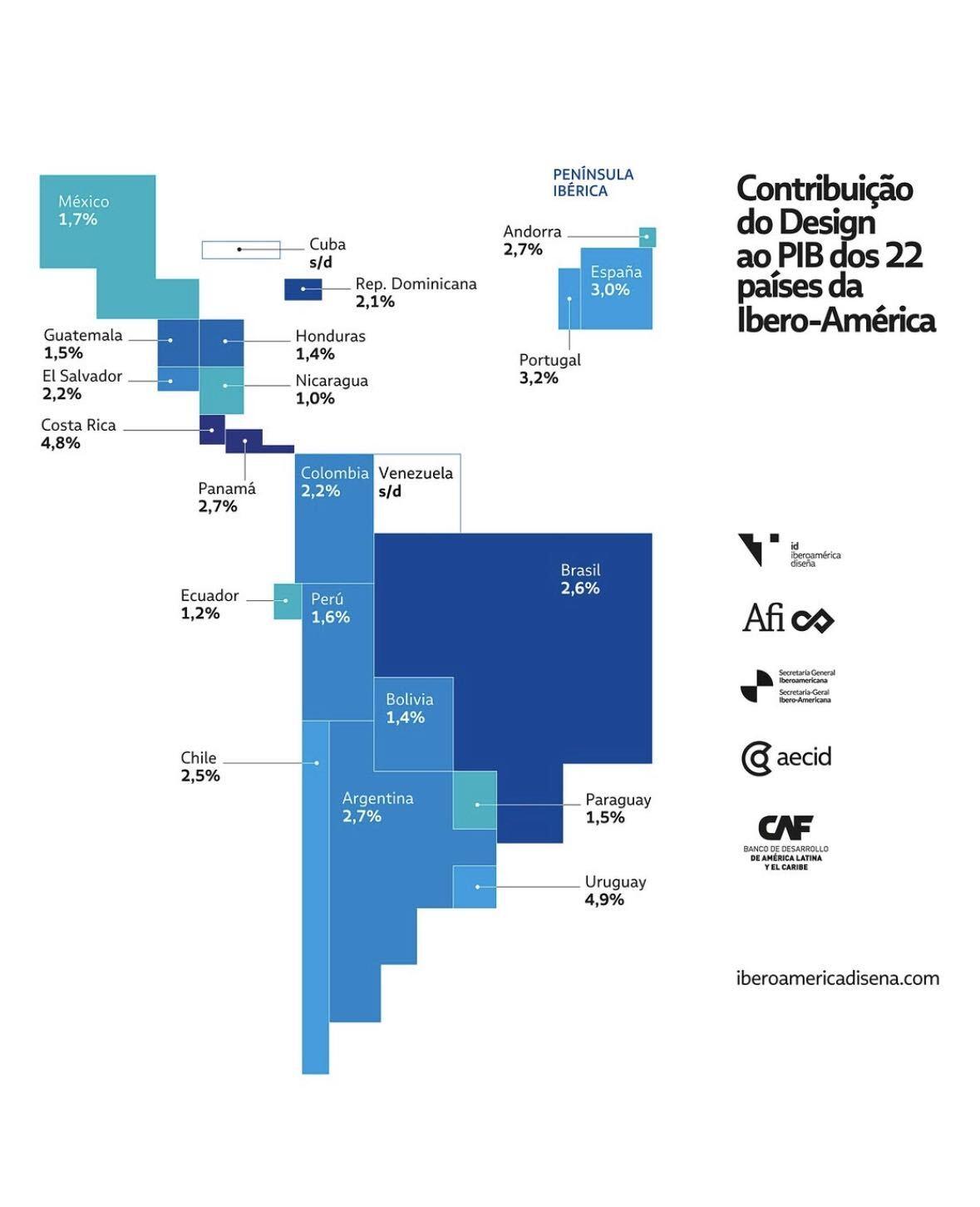
One regional data point offers another way to look at the question. The study “Factor Design: the economic relevance of design activities in Ibero-America”, led by Ibero-América Diseña, is the first to measure the weight of design in the region: €184 billion in value added, or 2.4% of GDP across the 22 countries. Design services account for 0.7% of GDP and 1.8 million jobs, and design-related activities for 1.7% of GDP and 3.3 million jobs. In Brazil, design accounts for 2.6% of GDP, above the regional average, which is led by Uruguay (4.9%) and Costa Rica (4.8%). The study measures design's economic weight, not job trends, so it doesn't tell us how much of that work will stay with people who hold the title of designer.
What the sources show most clearly is a change in the kind of work: defining the problem, separating certainty from risk, building, caring about craft, defining how to evaluate what AI produces, designing for agents, working alongside AI, building systems that let PMs, devs and stakeholders generate interfaces with AI, and saving research for the changes that need a human eye. Each of these depends on someone with judgment, and how we develop that judgment is still being figured out.
To my fellow design leaders: let's walk this road together and share what's hurting, so we all grow, make fewer mistakes, and have some real say in where the market goes next.
If you are seeing something different on your team, let's keep the conversation going.
Sources
- Pedro Belleza, "Estou preocupado com o futuro do UX Design" (I'm worried about the future of UX Design), UX Collective Brasil, November 2026
- Rodrigo Lemes, "The world needs more design. But does it need more designers?", DesignTeam, Nov 11, 2026
- Lenny Rachitsky, "State of the tech job market: late 2026", Lenny's Newsletter, Nov 10, 2026
- Tom Scott, post on Lenny's report, LinkedIn, November 2026
- Karim Lakhani, "Professor de IA de Harvard: Quem mais corre risco com a IA não é quem você imagina" (Harvard AI professor: those most at risk from AI aren't who you think), Silicon Valley Girl, Nov 1, 2026
- Shishir Mehrotra, "CEO da Superhuman: Como Se Preparar Já Para a Próxima Fase da IA" (Superhuman CEO: how to prepare now for the next phase of AI), Silicon Valley Girl em Português, Sep 24, 2026
- Y Combinator, "The New Full-Stack Designer", Design Review with Marvin Schwaibold, Oct 26, 2026 (based on the video description)
- Bruno Okamoto, "7 negócios de IA que o Vale do Silício já enxerga" (7 AI businesses Silicon Valley already sees coming), on Greg Isenberg's thread, Oct 18, 2026
- McKinsey, "The judgment bottleneck: Balancing AI and human speeds in strategy", McKinsey Quarterly, Oct 15, 2026
- McKinsey, State of AI 2026
- Designer Fund and Foundation Capital, AI in Design Report 2026, March to May 2026 (906 designers in more than 60 countries)
- Figma, 2026 AI Report
- Workday, "Beyond Productivity", January 2026 (coverage by ERP Today)
- Wellhub, Panorama do Bem-Estar Corporativo 2027 (Corporate Wellbeing Outlook 2027), October 2026
- Anthropic Institute, "How employment is changing at Anthropic", Oct 16, 2026 (coverage)
- Stanford Digital Economy Lab, "Canaries in the Coal Mine?", 2025
- Dell'Acqua, Lakhani et al., "Navigating the Jagged Technological Frontier", Organization Science, 2026
- Ibero-América Diseña: design generates more than €184 billion in value added in Ibero-America, 2.4% of the region's GDP. Instagram post

Rodrigo Peixoto has 26 years of experience in digital, 16 of them in UX and Product and 7 leading teams. He coordinated the redesign of Bradesco's internet banking at Publicis Groupe and, as a Manager at Grupo Casas Bahia, built the DesignOps team from scratch to support a 140+ operation. He has worked as an AI consultant and trainer since 2022 and teaches in Impacta's UX MBA program.