At many companies, teams bring in design only after they've made the big decisions. The scope is locked, the deadline is set, and the request arrives: "Now make the screens." The product looks great and ships on time. A few months later, almost nobody uses the new feature.
The problem is rarely the quality of the screens. It's when the team brought design in. That's what upstream design is about: involving design in decisions about what to build and why, before the first screen exists.
In this guide, you'll learn what the term means and how it shows up in a product team's day-to-day work. You'll also see why involving design early has become a business decision, especially now that AI can generate interfaces in minutes. At the end, you'll find five steps to bring design to the start of the process on your team.
What is upstream design?
The term comes from the image of a river. Upstream is toward the source; downstream is toward the mouth. Whatever happens at the source flows down and affects everything after it.
The pair shows up in other fields, too. In the oil industry, upstream is exploration and production, while downstream is refining and distribution. In digital products, the river is the sequence of decisions in a project.
In the upstream stretch, the team decides what to build and why: strategy, user research, and problem definition. In the downstream stretch, it decides how: screens and prototypes, specification, development, and launch.
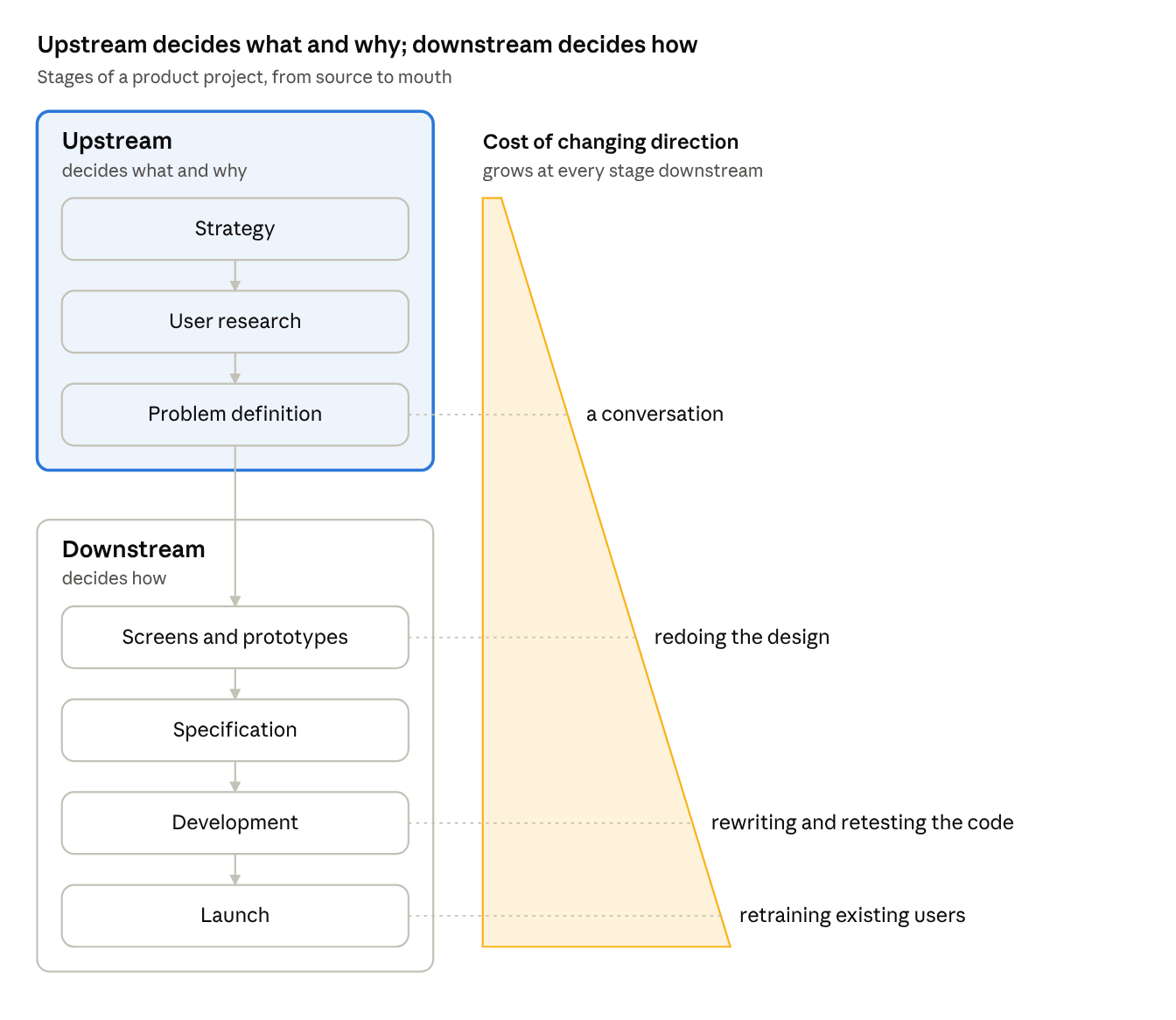
The first three stages define what the next four carry out, and changing course gets more expensive at every stage.
Upstream design is design that takes part in that first stretch. The designer helps choose which problem to solve instead of getting a ready-made solution to turn into screens. Downstream work doesn't go away, but it now carries out a decision that design helped make.
The line between the two stretches isn't rigid. A quick prototype, for example, can still serve upstream, testing whether an idea makes sense before the team commits to it.
Upstream vs. downstream in practice
Imagine your team gets this request: "Add a button to export the report as a PDF." There are two ways to respond.
The downstream response is to design the best possible button: well placed, with a clear icon, a loading state, and an error message. The button ships on time and works. Nobody asks whether it solves the real problem behind the request.
The upstream response starts with a question: why do people export this report? After talking to a few users, the designer learns that the PDF is how users send the report to their managers for approval. The export is just a detour on the way to an approval.
With that insight, the solution changes. A shareable link with an approve button solves the real problem, records who approved it and when, and may make the PDF unnecessary.
Sometimes the research confirms the original request, and the PDF really is the right answer. In that case, the team builds with more confidence because it knows why it's building.
Why moving design upstream is a business decision
For product leaders, the question isn't whether design is good, but when it comes in. Three reasons explain why that timing shapes results.
Changing direction costs less at the start
While the team is still defining the problem, changing your mind costs a conversation. Once the screens are done, it costs redoing the design. Once development is underway, it costs rewriting and retesting the code. After launch, you also have to retrain existing users.
Every stage downstream piles up work that a change of course undoes. That's why the cheapest time to find out the request was wrong is before the first screen.
AI made screens cheap, not decisions
AI tools can now generate screens and clickable prototypes from a text description. Producing an interface has become fast and cheap. Choosing which interface should exist is still hard.
When anyone on the team can generate a screen in minutes, the bottleneck moves. It shifts from production to decision-making: which problem to tackle, for whom, and what success looks like. That's upstream work. Using design only to produce screens means investing in exactly the part that got cheap.
Companies that treat design as strategy grow faster
In 2018, McKinsey published The Business Value of Design, a study that tracked 300 publicly listed companies over five years. Companies in the top quartile of its design index saw 32 percentage points higher revenue growth than their industry counterparts. Their growth in total returns to shareholders was 56 percentage points higher.
The study shows correlation, not causation. But the practices it links to top performers match upstream design. Among them: measuring design performance with the same rigor as revenues and costs, and bringing in user insights from the very first idea.
Many companies still skip this. The same study found that only around half of the companies surveyed conducted user research before generating their first design ideas. And, in the report's words, "over 40 percent of the companies surveyed still aren't talking to their end users during development."
5 steps to bring design upstream on your team
If design gets requests with the solution already spelled out, sits outside planning, and reports success in screens delivered, it's stuck downstream. These steps put upstream design into practice without reorganizing the company.
- Bring design in before a solution exists. Include designers in planning and roadmap conversations, alongside product and engineering. Many teams set this up as a product trio, in which the three disciplines decide together what goes into each cycle.
- Swap the screen request for a problem. Instead of "We need a filters screen," bring something like "Managers struggle to find late orders." A good problem statement says who feels the pain, what happens today, and why it matters.
- Make time for discovery. Discovery is where you investigate the problem before building, through interviews, data, and quick prototype tests. It doesn't have to take months: a few days of research cost less than rebuilding a feature nobody uses.
- Define success before designing. Agree on which number should move if the solution works. It could be the conversion rate, the time to complete a task, or the volume of support tickets. With the criteria written down first, the design discussion stops being about taste.
- Measure design by outcomes, not screens delivered. The number of screens shows output, not impact. After launch, check whether the agreed number moved, and carry what you learned into the next cycle.
What to look for in a designer who works upstream
Doing upstream design takes skills that don't always show up in a portfolio of polished screens. Some companies already write this into their job descriptions.
GitLab's experience organization (design, research, and brand) is called Upstream Studios. It states its position plainly: "We're not downstream, executing on decisions made without us." Its product designer job description expects senior designers to operate upstream "before direction is set." They should "shape roadmap priorities by bringing validated user needs and compelling evidence to planning discussions."
When hiring, four signals help you spot someone who works upstream:
- Case studies that start with the problem. The portfolio shows the context, the starting question, and the options they ruled out, not just the final screens.
- Research and discovery as routine. The candidate explains how they investigated the problem: who they talked to, what data they looked at, and which hypothesis they tested.
- Measured outcomes. Case studies end with what changed after launch, not with "the project was delivered."
- Facilitation across business and engineering. The candidate can run a prioritization conversation and negotiate scope with product and engineering.
In interviews, two questions tend to reveal an upstream designer:
- "Tell me about a project where you changed what was going to be built."
- "What do you do when a request arrives with the solution already decided?"
Frequently asked questions about upstream design
Is upstream design the same as strategic design?
They're related, but not the same. Strategic design describes a type of work: applying design to business, portfolio, and organizational decisions. Upstream describes the moment design enters the process. A designer can work upstream on a single feature without touching company strategy.
Does upstream design make downstream work less important?
No. A good decision executed poorly still fails. Interface, accessibility, and interaction details still determine whether people use the product. The point is that execution can't make up for a wrong decision, so design needs to be at both ends.
What does upstream mean in a design system?
In design systems, the term follows common software usage: upstream is the original source, and downstream is whatever consumes it. The central component library is upstream, and the products that use it are downstream. A fix made upstream reaches every product; a fix made in a single product creates drift.
Conclusion: design pays off most at the source
Upstream design is, at its core, a decision about timing. It means bringing design in while you can still change course, not just when it's time to make the screens. That way, the team spends less on rework and improves its odds of launching something people actually use.
To get there, you need designers who can work from the problem definition onward. At Deeploy, we recruit and place UX/UI designers for companies in the US, the UK, Brazil, and Portugal.
Talk to Deeploy and tell us what kind of designer your team needs.

Na Deeploy, acreditamos que grandes produtos começam pelas pessoas certas. Somos especialistas em recrutamento para UX, Produto e Design Digital e criamos conteúdos, conversas e conexões que fortalecem o mercado e aproximam talentos, empresas e líderes que estão construindo o futuro.