
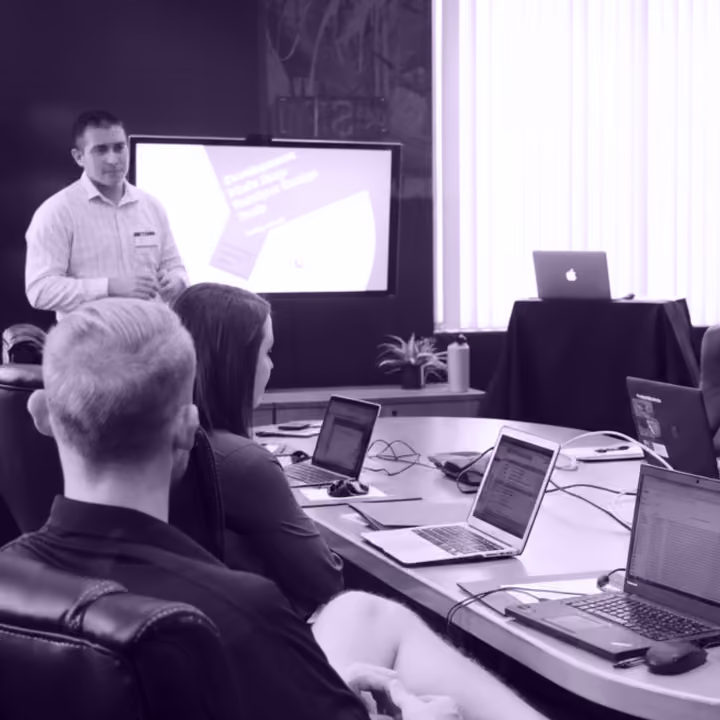
In many companies, Design grows before operations mature. The business expands, the team grows, products multiply, new squads emerge, research becomes more frequent, design systems appear, content production gains volume, and for a while, talent and goodwill seem enough to sustain evolution.
Until the symptoms start to appear: rework between teams, inconsistent experiences, misaligned rituals, scattered knowledge, nonexistent, slow, or insufficient onboarding, low predictability, excessive dependence on specific people, difficulty measuring impact, and the constant feeling that too much energy is being spent just keeping the machine running. That is when DesignOps stops being a desirable topic and becomes a strategic necessity.
Contrary to what many people believe, DesignOps does not exist to bureaucratize design work. Its goal is to create the conditions for design to achieve higher quality and function better at scale. The Nielsen Norman Group defines DesignOps as the orchestration and optimization of people, processes, and practices to amplify the value and impact of design at scale. The same reference highlights that DesignOps helps organizations deal with challenges such as team growth, efficient workflows, and improving the quality and impact of design deliverables.
Structuring DesignOps is not just about “organizing the house.” It is about reducing the often invisible cost of disorganization and transforming individual best practices into organizational capability.
Why Talk About DesignOps Now?
The pressure on Design and Product teams has increased. Companies need to deliver faster, with greater consistency, more integration between areas, and clearer evidence of impact. At the same time, digital environments have become more complex: multiple products, channels, journeys, disciplines, and now, different ways of using artificial intelligence throughout the process.
In this scenario, operating Design based solely on individual effort is no longer sustainable. Many companies have outstanding professionals in UX, Product, Research, Content, Technology, and Data, yet still face recurring problems because knowledge is scattered — often “inside a few people’s heads” — processes are unclear, quality criteria vary between teams, and decision-making depends too heavily on corporate relationships.
When each squad creates its own workflow and every individual interprets quality differently, the company loses scale and the experience becomes fragmented. The same happens when onboarding is outdated: new professionals take longer to understand how the organization works, while important decisions remain restricted to meetings or private conversations. As a result, knowledge does not circulate, learnings are lost, and teams become overly dependent on informal context. In addition, when Ops-focused professionals spend a large portion of their time on tasks that could be handled by Product Designers, strategic capacity is wasted.
These problems come at a high cost. They appear in hours spent reworking decisions, unclear handoffs, difficult-to-find research, duplicated components, inconsistent flows, repeated questions, low adoption of best practices, and the difficulty of demonstrating value to leadership.
That is why DesignOps matters even more now.
So, What Is DesignOps (and What Isn’t It)?
It is still common to associate DesignOps with tasks such as organizing files, managing tools, supporting rituals, or facilitating internal events. All of these may be part of the discipline. But DesignOps is much broader than that.
DesignOps is the infrastructure that enables design to operate with consistency, quality, and scale. This infrastructure involves people, processes, governance, knowledge, tools, workflows, standards, collaboration methods, and metrics.
The Nielsen Norman Group organizes DesignOps into three major areas: how we work together, how we execute work, and how work generates impact. This framework helps clarify that Ops is not just about internal processes, but also about collaboration, execution, quality, and perceived organizational value.
In practice, a DesignOps area may work on initiatives such as:
- Defining roles, responsibilities, and rituals;
- Evolving discovery, delivery, and handoff processes;
- Creating and governing design systems;
- Structuring guides, playbooks, templates, and documentation;
- Onboarding and enablement;
- Knowledge management;
- Integration between Design, Product, Technology, Data, Business, and Customer Support;
- Defining and monitoring metrics;
- Supporting the maturity of disciplines such as content, research, accessibility, and measurement;
- Creating mechanisms for responsible AI adoption in design processes;
- Increasing Design’s visibility and perceived impact inside and outside the company.
But it is equally important to clarify what DesignOps is not. DesignOps is not control for the sake of control, doing the Product Designer’s job, centralizing every decision, removing team autonomy, or turning design into a production line without critical thinking.
A strong design operation creates standards without preventing adaptation, and governance without adding unnecessary bureaucracy or slowing delivery. The goal is not to make everyone work in exactly the same way. The goal is to create a shared foundation so teams can collaborate better, reuse knowledge, reduce friction, and deliver more consistent experiences.
The Pillars of a Mature Operation: ProductOps, ContentOps, ResearchOps, MetricsOps, and AccessibilityOps
A mature design operation is not limited to visual interface processes. It involves different disciplines that together help create more consistent, accessible, measurable, and business-aligned experiences.
Not every company needs to start with all these functions formally established. Maturity can evolve progressively. What matters most is understanding that DesignOps works as an integrative layer: it connects practices, reduces silos, and helps different specialties operate with greater clarity.
ProductOps helps organize the relationship between strategy, discovery, delivery, prioritization, and decision-making. In complex environments, this discipline can improve rituals, workflows, prioritization criteria, cross-functional integration, and visibility into ongoing initiatives.
ContentOps structures content operations. This includes language guides, voice and tone, editorial standards, templates, review workflows, governance, enablement, and ways to measure quality and impact. In organizations with many products and channels, ContentOps helps reduce inconsistencies, avoid rework, and make communication clearer for users.
ResearchOps creates the conditions for research to happen with quality, ethics, and scale. This involves recruitment, repositories, participant management, data governance, method standardization, organizing findings, and democratizing knowledge. Without ResearchOps, many insights are lost or remain restricted to a few teams.
MetricsOps strengthens a measurement culture. This discipline supports indicator definition, data interpretation, the connection between UX and business, and models for tracking UX and business impact. It is essential for moving design away from subjective perception and closer to evidence-based decision-making.
AccessibilityOps helps embed accessibility into the process instead of treating it as a final checklist. This includes guidelines, documentation, enablement, quality criteria, testing, governance, and integration with design systems, content, and technology.
In more mature organizations, these specialties may exist as dedicated teams, chapters, guilds, or specialized roles. In earlier-stage companies, they may begin as initiatives led by specialists, leaders, or working groups.
How to Structure DesignOps: Models, Governance, and Real Learnings
There is no single correct model for structuring DesignOps. The design of the area depends on the company’s maturity, team size, organizational culture, product distribution, squad autonomy, and the complexity of the disciplines involved.
Still, three models frequently appear: centralized, decentralized, and hybrid.
In the centralized model, an Ops team or core works cross-functionally, creating guidelines, processes, standards, rituals, templates, documentation, and metrics for the entire organization. This model is often strong for companies that need consistency, shared foundations, and reduced fragmentation.
Its advantage lies in systemic vision. A centralized team can identify recurring patterns, consolidate learnings, and create reusable assets for the entire design community. The risk lies in losing local context: if the operation becomes too distant from squads, it may create solutions that look correct on paper but lack practical adherence.
In the decentralized model, Ops professionals or trios work closer to product fronts, business units, or squads. This model favors contextual understanding, proximity to real problems, and faster responses. The operation becomes more connected to daily work.
Its advantage lies in adaptability. The risk lies in fragmentation. Without minimum governance, different areas may create conflicting standards, duplicate efforts, or lose consistency across products.
That is why, in complex organizations, the hybrid model is often the most realistic. It combines a cross-functional layer of strategy, governance, and standards with distributed execution close to business contexts.
In this model, some decisions need to remain shared: principles, guidelines, quality criteria, key metrics, alignment rituals, taxonomies, base templates, and documentation standards. Others can be adapted locally according to products, teams, and journeys.
The key question becomes: What needs to be standardized to ensure consistency? And what needs flexibility to preserve context? That distinction is fundamental.
What I Learned Structuring ContentOps at Banco do Brasil
One of the most important Ops experiences I had was at Banco do Brasil, where I worked as ContentOps Lead in the Governance and Operations team led by Felipe Neves, within a centralized structure in the UX Center of Excellence that supported a community of more than 700 designers.
In a context of that scale, isolated actions were not enough. It was necessary to create foundations, a shared language, and scalable mechanisms. That is why initiatives such as the BB UX Writing Guide, the UX Writing macro-process, onboarding for the discipline, the Figma Template Library, the prompt bank, the portal, and the knowledge pills became relevant. They functioned as parts of a system: helping standardize what needed standardization, reducing repetitive effort, supporting decision-making, and expanding access to quality references.
Key learnings:
- It is essential to map and value the work already done by professionals who “cleared the path” before your arrival, such as Auana Pontes de Andrade and an incredible team of UX Writers like Lídia Dourado.
- Documentation without practice becomes an archive, templates without governance become decorative files, and guides without adoption strategy become good intentions.
- To generate real impact, you need exceptional professionals by your side, such as Giovana Ferreira and Amaraline Vasconcelos, while combining structure, education, communication, governance, and metrics.
- It is essential to treat the design community as an internal user base: listen, test, adjust, co-create, measure adoption, and continuously evolve. Participating in critiques, offering consultations and mentoring, and staying close to product contexts makes a significant difference.
- Partnership with ResearchOps was essential for consistency, growth, visibility in internal events, and maintaining sanity throughout the process. Thanks to Pedro Vargas, Laura Bior, Mariana Izukawa, and Edilana Cerqueira.
- Well-designed operations democratize quality. When knowledge stops being concentrated in a few people and becomes available through reusable formats, more professionals can make better decisions with greater autonomy. This frees senior professionals to focus on more complex problems instead of repeatedly solving the basics.
The Challenge and Opportunity of Maturing Ops at Inter
At Inter, Ops has evolved alongside the organization. Over time, different formats were tested: more centralized models, structures organized by business avenues with Content, Research, and Metrics trios dedicated to product goals, and more recently, a configuration with specialists guiding discipline strategies while trios work close to business fronts.
This journey reinforced an important lesson: Ops must respond to the company’s current needs, maturity, and organizational design — not the other way around.
From September 2025 to March 2026, I worked in UX Core under the leadership of Isadora Diniz as a Content Designer Specialist II focused on innovation and capability foundations, contributing to the development of Inter’s Super App, Platforms, and Channels.
During this period, I saw an opportunity to help structure DesignOps and, in partnership with Ops-focused professionals, promoted the definition of Ops Mission, Vision, and Pillars, followed by the roadmap connecting initiatives to those pillars and gradually bringing visibility to leadership about our deliveries.
Starting in April 2026, I took on a new challenge as Ops Lead & ContentOps within the Design System and Ops team led by Paulo Aguilera, focused on transforming Design, Content, Research, Metrics, and Accessibility into drivers of efficiency and business impact. My role is to build bridges between user experience and organizational goals through strong governance and scalable processes.
Now, the challenge is defining which elements must remain shared, which can remain local, and how to create alignment mechanisms without suffocating team autonomy. Onboarding, documentation, templates, tools, metrics, exchange rituals, and quality criteria act as connectors: they help sustain quality and consistency in an environment formed by different teams, rhythms, and contexts.
In this scenario, Ops acts less as a centralizing authority and more as an orchestrator. The discipline helps evolve practices, give visibility to existing work, reduce duplication, strengthen specialties, and create foundations for Design to scale without losing quality.
Another important lesson is that this work does not necessarily need to begin inside a formally established area or perfectly organized team. Often, Ops starts with proactive, competent, and innovative professionals who identify opportunities to improve how teams work.
At Inter, this can be seen in initiatives led by professionals such as:
- Adriana Tamie Akamine, dedicating exclusive time to Ops activities with squad stakeholders;
- Marciana Xavier, creating an internal website;
- Marcia Clara Borba, scaling design system quality;
- Tobias Paiva, using UX data more strategically;
- Guilherme Machado, documenting usability testing best practices for 60+ audiences;
- Jessika Viveiros, documenting Plain Language best practices for digital products;
- Sâmara Cipriano, creating an AI agent focused on Content within Slack;
- Isadora Aguiar, starting a conversational AI project;
- Karina Salles, partnering with me on UX Content Skills Mapping;
- Letícia Ribeiro, training Product Designers to build their own dashboards.
The same movement appears in customer proximity initiatives, such as Research Talks led by Leonardo Barbosa; internal branding initiatives by Lucas Pedroso; AI-related illustration studies by Ozy Rodrigues; and discussions on connecting design results to business outcomes, such as those led by Geovanni Oliveira.
Visibility is also part of this movement. It appears in intern iniciatives, such as accessibility talks with Guilherme Cosme and Ana Cuentro, Design System result presentations with Eduardo Lara Rabelo and Lucas Berquó, leadership interviews such as the one with UX coordinator and writer Monica Barros, participation in universities with Daniel Gamarano and Francielly Maia, industry events with Guilherme Cestaro and Luiza Antunes, and social media initiatives with Luiz Matos.
Gradually, these and many other initiatives stop being isolated efforts and become shared organizational learning, helping build a clearer, more efficient, and more sustainable operation.
In Ops, nothing is built alone — and that is a good thing.
DesignOps Is a Scaling Decision
Structuring DesignOps means recognizing that design does not scale simply by adding more people, more tools, or more deliverables. Design scales when the company creates a system capable of sustaining quality, clarity, efficiency, and governance over time — always investing in people.
And in a scenario where companies must deliver increasingly complex digital products with greater speed and less waste, this is no longer just a conversation for the UX community.
DesignOps has become a business conversation.
Follow Alê Periard:
Medium: https://medium.com/@aleperiardux
LinkedIn: https://www.linkedin.com/in/aleperiard
Instagram: https://www.instagram.com/aleperiardux
TikTok: https://www.tiktok.com/@aleperiardux
YouTube: https://www.youtube.com/@aleperiard
.avif)
Alê Periard has more than 20 years of experience in content. Currently, she works as Ops Leaf & ContentOps at Inter, teaches UX Writing at PUCRS and UX Research at UniLaSalle, and is the founder of Escrita.co and the communities Clube do UX Writing and ContentOps Brasil. She is also a writer and content creator. Throughout her career, she has worked at major digital and financial companies, including Banco do Brasil, Itaú Unibanco, Mercado Livre, Mercado Pago, and iFood.