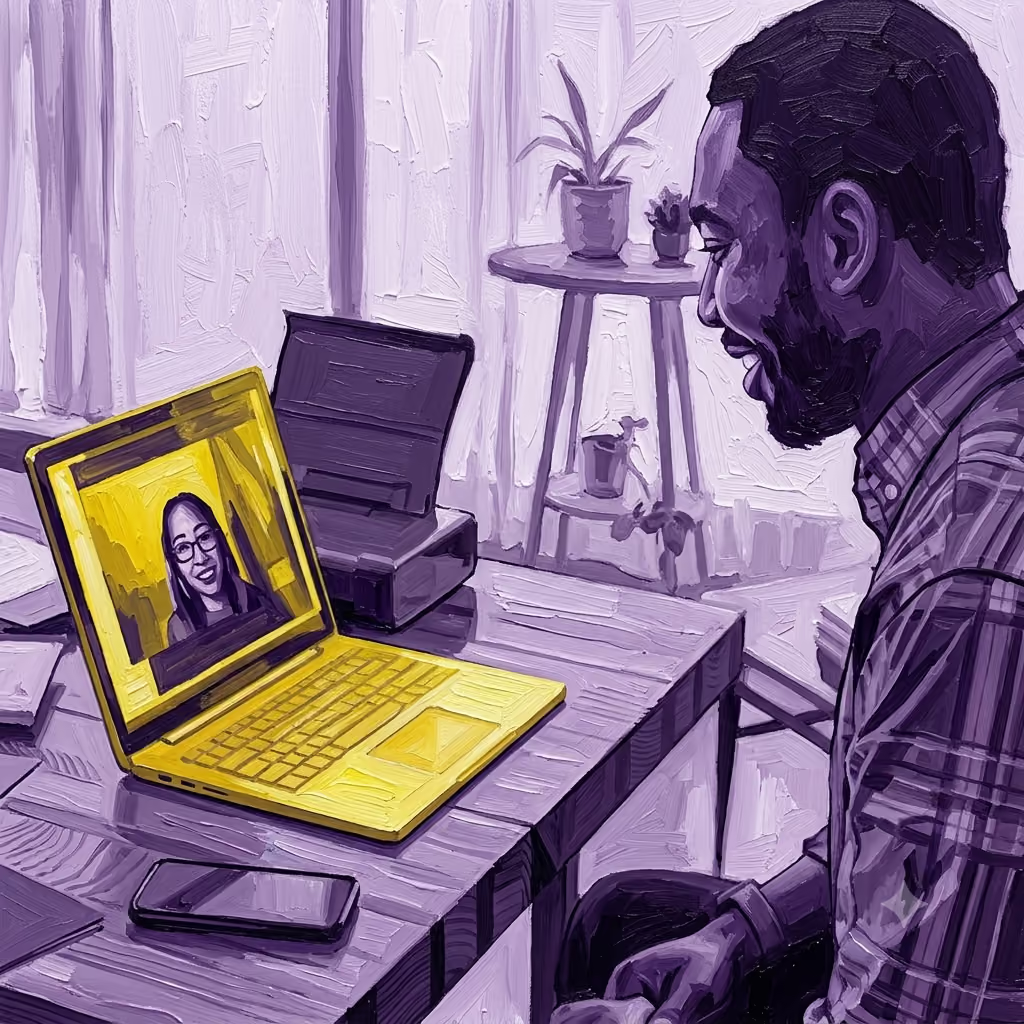
On November 5, Brazil celebrates Graphic Designer's Day, chosen to honor the birth of Aloísio Magalhães, one of the pioneers of Brazilian design. It's a good moment to look back: from Gutenberg's movable type to artificial intelligence, the designer's tools have changed completely. With every disruption, someone predicted the end of the profession — and each time, it moved one step up the decision chain.
From a desk drawer to a laptop
Ask a designer in 1960 what they brought to work, and the list would fit in a drawer: technical pens, rulers, rubber cement, a sharp craft knife. Ask the same question today, and the answer might be a laptop and half a dozen software subscriptions, one of which can generate images from a sentence. Between one and the other lies the story of a profession that has changed its tools many times, and its place almost as often.
For centuries, the person who designed a page was the same person who printed it. Then came the commercial artist, hired to decorate what industry had already decided to make. In the 20th century, designers began to plan objects, organize entire brands, and think about how people use a product. Now, facing artificial intelligence, the old question returns: what, exactly, does a designer do?
Even the name of the craft is younger than it seems. The term “graphic design” gained prominence in 1922, when American designer William Addison Dwiggins used it in a newspaper article about his own work, and it only became widespread after World War II. Before that, what we now call design was split among typographers, engravers, lithographers, and commercial artists. This is the story of how those roles merged into one, and how they branched out again.
When the designer was the printer (1450–1850)
Around 1450, in Mainz, Johannes Gutenberg built the movable-type press that launched printing in the West. For nearly four centuries after that, the person who decided how a book looked was the printer. Printers chose the typefaces, set the margins, columns, and drop caps, often edited the text, and sold the finished volume. Designing and producing were one and the same, done in the same workshop and passed down from master to apprentice.
“If it couldn’t be set in lead, it simply didn’t exist on the page.”
Letters were born in the hands of punchcutters. Claude Garamond in the 16th century and Giambattista Bodoni in the 18th designed and carved in steel the punches from which metal type was cast, an alloy of lead, tin, and antimony. The compositor picked the letters one by one from the type case, with capitals kept in the upper case and small letters in the lower case, and lined them up in a composing stick. That's where the words uppercase and lowercase come from. Images were carved by hand in wood or metal with gouges and burins, and everything went through hand presses, first wooden, then iron, like the Stanhope press of 1800.
There was no gap between idea and execution, and the limits of the technique were the limits of form. If it couldn't be set in lead, it simply didn't exist on the page.
Posters take to the streets (1850–1919)
The steam engine reached print shops in the early 19th century and changed the scale of everything. Printing became fast and cheap, cities grew, and so did the demand for ads, labels, packaging, and newspapers for a mass audience. For the first time, designing and printing became separate jobs.
That's when the commercial artist was born: an illustrator or letterer hired to create the image the print shop would reproduce. In Paris, color lithography brought posters to the streets. Artists drew directly on limestone with a greasy crayon, one stone per color, and city walls filled with posters by Jules Chéret, Henri de Toulouse-Lautrec, and Alphonse Mucha. In the print shops, the Linotype machine of 1886 began casting entire lines of text from a keyboard, and the Monotype, a year later, composed and cast letters one at a time, also mechanically. And from the 1880s on, the halftone process let photographs appear in newspapers.
Not everyone liked what they saw. In England, William Morris and the Arts & Crafts movement responded to the ugliness of many industrial products by championing well-made craftsmanship. Morris's publishing house, the Kelmscott Press, founded in 1891, restored typography's status as an art.
Even so, commercial artists were treated as decorators. They came in at the end of the process to make the product attractive and had no say in what was being made.
Form follows function (1919–1945)
In 1919, architect Walter Gropius founded a school in Weimar that brought art, craft, and industry under one roof. The Bauhaus taught that form should arise from function, material, and manufacturing process, and that idea changed the designer's place. Instead of being called in to decorate, designers now planned objects and graphic pieces for mass production from the very start.
“Photomontage became a language, and the camera became a creative tool.”
The names from this period still come up in any typography class. Herbert Bayer redesigned the alphabet using only lowercase letters. László Moholy-Nagy brought photography and text together. In Russia, Constructivists such as El Lissitzky and Alexander Rodchenko turned design into a tool for propaganda and social change. In 1928, Jan Tschichold gathered these ideas in The New Typography: asymmetric layouts, sans serif type, clear hierarchy.
Work happened at the drafting table, with set squares, compasses, and ruling pens, but also with scissors and glue. Photomontage, made from cut and recombined photographs, became a language, and the camera became a creative tool. At the Bauhaus, the metal, wood, weaving, and printing workshops made design a hands-on experience.
Designers began talking with engineers and manufacturers. Under pressure from the Nazis, the school closed its doors in 1933, and its teachers emigrated to the United States and other countries, taking modernism with them.
The age of the drafting table (1945–1984)
After the war, design became an established profession, with schools, dedicated studios, and large corporations among its clients. Companies, governments, and events began commissioning complete visual identity systems, along with guidelines that defined colors, typefaces, and applications down to the last detail.
In Switzerland, Josef Müller-Brockmann and Armin Hofmann established the grid and the pursuit of objective communication, which found its signature typeface in Helvetica, released in 1957. The Ulm School of Design (HfG), open from 1953 to 1968, brought design closer to science, method, and industry. In the United States, Paul Rand designed IBM's identity, Saul Bass created logos and film title sequences, and the studio Chermayeff & Geismar produced logos that are still in use today. Designers became consultants, responsible for the image of an entire institution.
It was also the heyday of the drafting table. On the desk sat a parallel rule, set squares, a scale ruler, French curves, and technical pens like Rapidograph and Rotring, with calibrated nib widths. Headlines could be assembled with Letraset, the dry-transfer lettering launched in 1961 and rubbed onto paper one letter at a time. Text came from phototypesetting and was cut with a craft knife and pasted with wax or rubber cement onto boards with blue guidelines: the paste-up. A process camera enlarged and reduced elements, the Pantone system, from 1963, standardized colors, and colored pencils and markers handled presentation sketches.
“Designers became consultants, responsible for the image of an entire institution.”
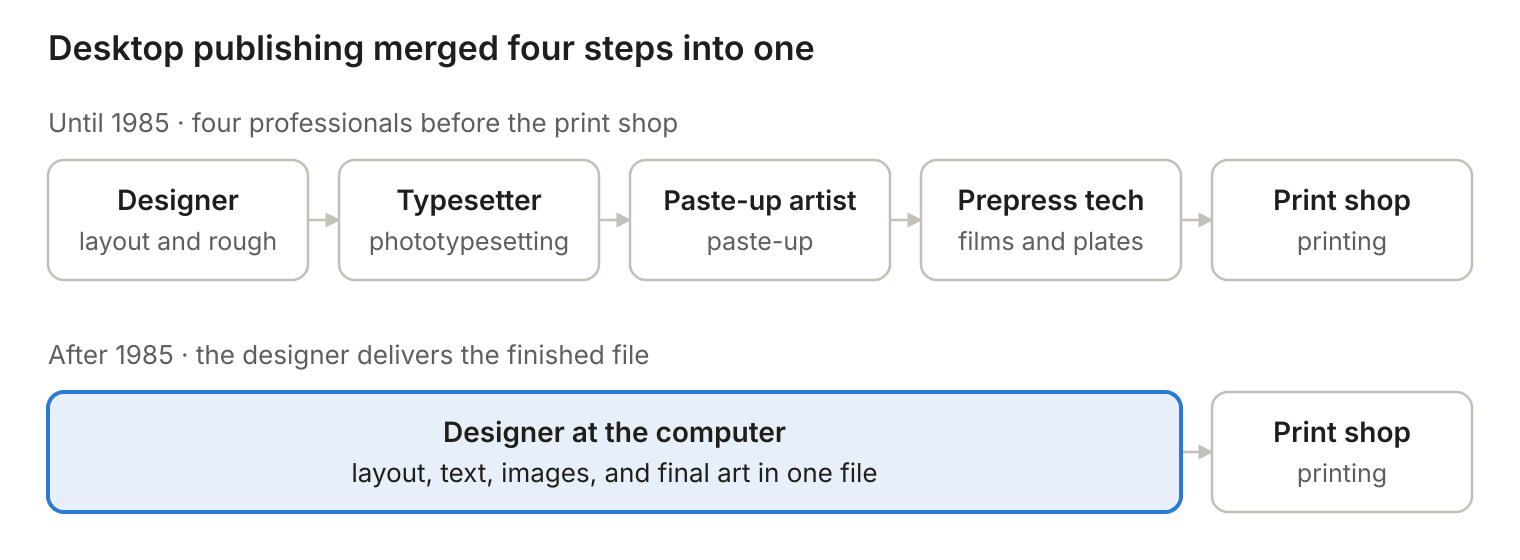
Between the idea and the printed page stood a line of professionals. The designer made the layout, the typesetter produced the text, the paste-up artist assembled the page, and the prepress technician made the films and plates. A single typo could mean resetting and re-pasting an entire column.
The computer reaches the desk (1984–2000)
Within two years, a personal computer dismantled that line. The Macintosh arrived in 1984. In March 1985 came the LaserWriter printer, with Adobe's PostScript language built in, and in July, Aldus PageMaker. Together, the three launched what became known as desktop publishing.
“Entire trades disappeared in less than a decade.”
On screen, with a mouse and a graphical interface, designers could now do alone what once required a typesetter, a paste-up artist, and a prepress technician, and what appeared on the monitor was what came out of the printer. Fonts became scalable digital files, first in the Type 1 format, then TrueType and OpenType. PageMaker soon faced competition from QuarkXPress, released in 1987 and dominant in newsrooms and publishing houses in the 1990s, until Adobe InDesign, released in 1999, took its place as the standard. For vector graphics there was Illustrator, also from 1987, and for images, Photoshop, from 1990. Flatbed scanners digitized material, and later, computer-to-plate (CTP) technology, which writes plates directly from the computer, made film obsolete.
With full control over the page, experimentation exploded. Zuzana Ličko and Emigre magazine created typefaces designed for low-resolution screens, and David Carson took typographic deconstruction to the extreme in the pages of Ray Gun. At the same time, anyone with a computer could “do design,” and the profession had to set itself apart through thinking, since the tools were within everyone's reach.
Entire trades disappeared in less than a decade, and the designer became the direct link between the idea and the print-ready file.
From layout to experience (2000–2015)
With the web and then the smartphone, design became something people use, not just something they see. The central question shifted from “How should this look?” to “How should this work for the person on the other side?”
New specialties emerged: web designer, interaction designer, information architect, and user experience (UX) designer, a term popularized by Don Norman at Apple in the 1990s. The launch of the iPhone in 2007 and of the app stores the following year created huge demand for mobile interfaces. In 2010, Ethan Marcotte proposed responsive design, and designers had to think about layouts that adapt to any screen. Meanwhile, design thinking, spread by IDEO and Stanford's d.school, brought design methods into company strategy.
Tools followed the change. Many designers learned the basics of HTML, CSS, and JavaScript. Dreamweaver and Flash dominated the web in the early 2000s, until Flash declined after 2010. Screens were designed in Fireworks or, with some stubbornness, in Photoshop itself. Wireframes and prototypes made in Axure or Balsamiq shared space with sticky notes and cards spread across workshop rooms, and interviews, usability tests, personas, and journey maps became routine.
“The central question shifted from ‘How should this look?’ to ‘How should this work?’”
Designers began entering the process earlier, side by side with developers and product managers. The result was no longer a finished piece but a product in constant change.
Design as a system (2015–2022)
From the mid-2010s on, designers stopped delivering standalone screens and started designing systems. At tech companies, design earned a seat in leadership, and work became collaborative in real time.
The product designer combines research, interaction, interface, and strategy in a single role and is measured by usage and business outcomes. Design systems gained ground: libraries of components, rules, and tokens that keep hundreds of screens consistent, such as Google's Material Design, launched in 2014. Designers reached roles like head of design and product director and learned to speak the language of metrics, A/B tests, and roadmaps.
Sketch, from 2010, was the first popular tool built specifically for interfaces. Figma, launched in 2016, brought the work into the browser, with simultaneous editing, comments, and shared libraries. Design handoff, once done in InVision and Zeplin, was absorbed by Figma's own inspect mode. Principle, ProtoPie, and Framer added motion to prototypes, Maze and Hotjar took research remote, and whiteboards like Miro and FigJam became the team's meeting room.
The design file became a living space, open to developers, managers, and clients, and the line between design and code grew ever thinner.
Facing the machine that creates (2022–today)
In 2022, tools like DALL·E 2, Midjourney, and Stable Diffusion began generating images from text. Soon after, AI features arrived in Photoshop, Figma, and other everyday programs. It's the profession's third major technical disruption, after the movable-type press and desktop publishing.
Generating variations of images, layouts, or text became fast and cheap. As a result, the designer's value is shifting from execution to judgment: defining the right problem, choosing among many options, ensuring consistency with the brand and with users' needs, and taking responsibility for ethical issues such as copyright, bias, and accessibility.
“As in 1985, entire tasks are being automated.”
Day to day, the toolbox now includes image generators like Midjourney and Adobe Firefly, generative fill and object removal, layouts and prototypes created from descriptions, and language assistants for writing, research, and interview analysis. AI-generated interface code lets designers test working ideas without depending on a developer. Many professionals are becoming curators, art directors of automated systems, and creators of conversational and agent interfaces.
As in 1985, entire tasks are being automated and the boundaries between roles are being redrawn. The history of the profession suggests that the designer's role won't disappear. It shifts and moves closer to the most strategic decisions.
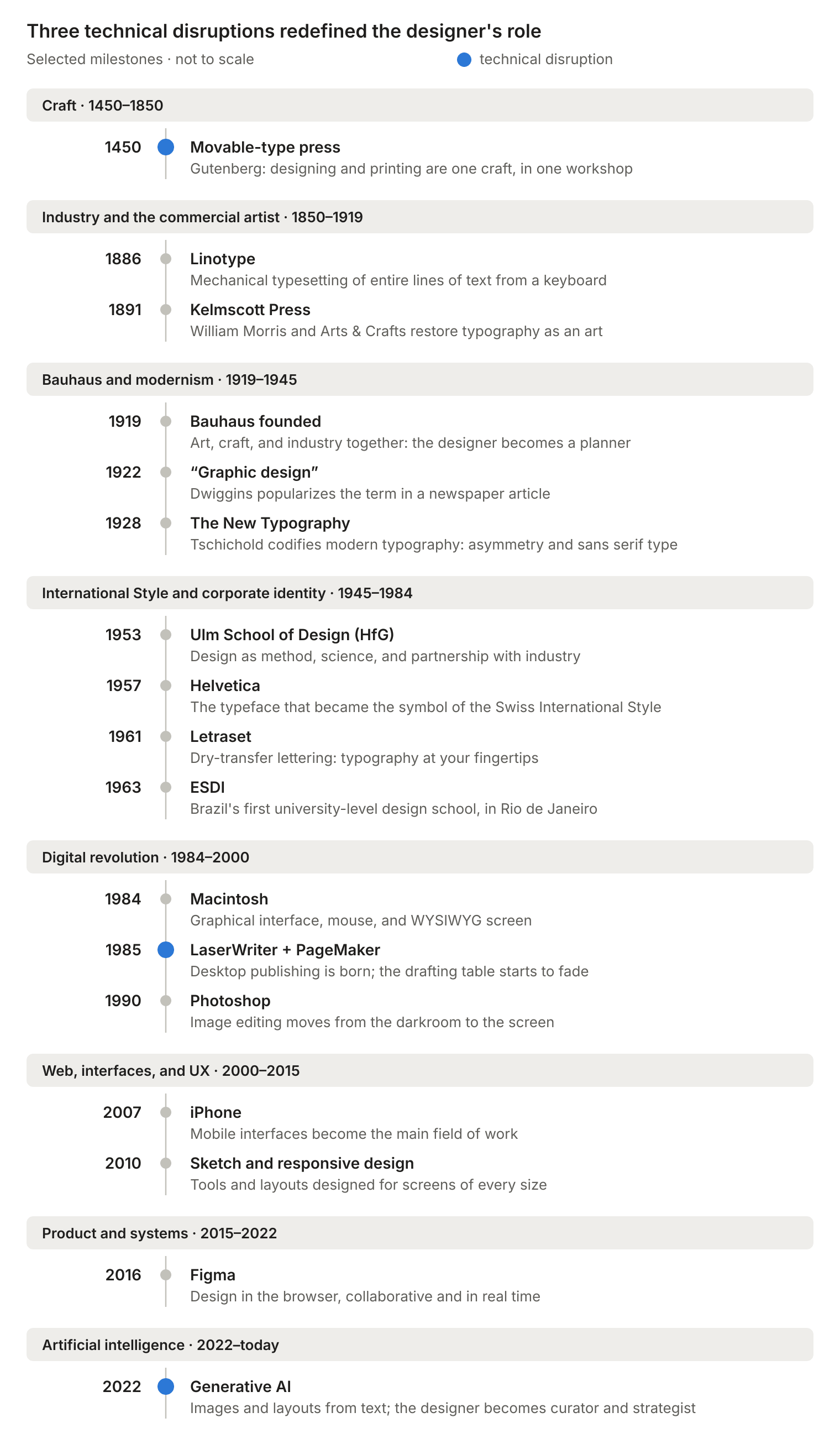
At a glance: the tools of each era
With each technical leap, designers lost a manual task and gained a broader responsibility.
Meanwhile, in Brazil (1951–1975)
Brazilian design became a profession in the 1950s and 1960s, strongly influenced by the Bauhaus and, above all, by the Ulm School. One of its starting points was the Institute of Contemporary Art at MASP, the São Paulo Museum of Art. Among the first students of its art foundation course, from 1951 to 1953, taught by Pietro Maria Bardi and Lina Bo Bardi, among others, was Alexandre Wollner, who in 1953 was recommended by Bardi for the first class of the HfG Ulm.
Back in Brazil, in 1958, Wollner co-founded forminform, one of the country's first modern design studios, with Geraldo de Barros, Ruben Martins, Walter Macedo, and Karl Heinz Bergmiller. Its work included the Coqueiro sardine cans and the identity for Atlas elevators. In Rio, in 1960, Aloísio Magalhães founded the studio M+N+P, later PVDI.
In 1963, the Escola Superior de Desenho Industrial (ESDI) opened in Rio de Janeiro as Brazil's first university-level design school, with a curriculum inspired by Ulm. Wollner, Bergmiller, and Aloísio helped create it, and in 1975 the school became part of the State University of Rio de Janeiro (Uerj).
Aloísio designed the identities of Petrobras, Light, and Banco Nacional, and in 1966 he won the Central Bank competition to design the banknotes for the new cruzeiro. His birthday, November 5, is now Graphic Designer's Day in Brazil, the date that inspired this article.
From then on, the path was the same as in the rest of the world: from the drafting table to the computer in the 1990s, and from agencies to tech companies in the 2010s.
What hasn't changed
From the composing stick to the prompt, the tools have changed completely, and with each change someone announced the end of the designer. The opposite happened. Each technical disruption pushed the profession higher up the decision chain.
Some things, however, have survived nearly six centuries intact. Designers still organize information so that someone can understand it and act, whether on a Gutenberg page, a Chéret poster, or a sign-up form. They still bridge technology and people, turning what each technology makes possible into something useful and understandable. And they still make choices: what goes in, what stays out, which hierarchy, which tone. Tools multiply the options; the designer decides among them.
If history is any guide, the designer of the next decade will spend less time executing and more time defining problems, setting criteria, and taking responsibility for the consequences of what they create. This November 5, that is the craft we celebrate.
At Deeploy, we recruit and place UX/UI designers for companies in the US, the UK, Brazil, and Portugal.
Talk to Deeploy and tell us what kind of designer your team needs.
References
- On Dwiggins's 1922 article and the origin of the term — American University
- Dwiggins and the term “graphic design” — University of Cincinnati Libraries
- Desktop publishing and LaserWriter — Wikipedia
- The Apple LaserWriter and the desktop publishing revolution — Museums Victoria
- Rub-down revolution: the story of Letraset — Eye Magazine
- Graphic Means: a history of graphic design production — Computer History Museum
- A bridge to the world: Alexandre Wollner — Revista Pesquisa FAPESP
- Biography of Aloísio Magalhães (in Portuguese) — eBiografia
- Aloísio Magalhães — Wikipedia
Further reading: Philip B. Meggs and Alston W. Purvis, Meggs' History of Graphic Design (Wiley), and Rafael Cardoso, Uma Introdução à História do Design (Blucher, in Portuguese).

Journalist with 8 years of experience in communication, now working as a UX Writer and author of Deeploy’s blog, I’m Victória Kiomy. Half Brazilian, half Japanese, I’m passionate about meaningful conversations, problem-solving content, and anything that brings people closer to simpler, more human experiences.