

I've been working in design for thirty years, and I spent a good portion of that time hiring people. I started out selecting interns when I barely knew what to ask myself, and today I build and lead entire teams. If I've learned anything along the way, it's that hiring isn't about finding the most brilliant resume. It's about trusting your own evaluation skills and the candidate, but mostly what they can become within a context that doesn't exist yet—that is, them within the team.
Perhaps because I'm a teacher and organize collectives here in São Paulo, I've always viewed the selection process as an encounter, not a filter. On the other side of the table is someone who made time, rehearsed answers, dressed carefully, and brought a dose of hope. Forgetting this is the first mistake of anyone who hires.
How I Think About Hiring
My process has changed little in essence, even with so many new tools that filter candidates, conduct interviews with virtual agents that give feedback, or even operate via WhatsApp. I start with the hardest question: what problem is this person coming to solve? There is no generic vacancy; there is the real problem of the team at that moment. There is a business objective to be achieved, a technical challenge to be worked on. From there, I look for three things, in this exact order:
- First, how the person thinks: because technique can be taught, but reasoning cannot.
- Second, how they handle what they don't know: since real work is made of uncertainties.
- And only last, technical repertoire: which is usually what appears most on the resume and says the least about the future.
And here I need to be honest about one thing: I like to go against the conventional. I don't believe in hiring as a mathematical calculation, as much as there are techniques to evaluate people. Our lives are surrounded by uncertainties, and the hiring process goes through that too—both for the company and for the candidate. The interview context will always be different from the daily work context, and the manager must be aware of that.
I prefer an attentive, curious person with a willingness to learn over an impeccable resume and a closed mind. I have put many people to work in roles where they had no prior experience, and I would do it all over again. Certain skills can be taught, trained, and built over time. What you cannot teach is attentiveness, a hunger to learn, and the fresh perspective someone brings precisely because they haven't done it the usual way. People without prior industry experience or a background in that specific activity, without the "right" credentials, usually see what others have stopped seeing—and who sometimes keep repeating habits in the name of "I've already done this and I know how it is."
And here we even face a challenge: how to balance hiring those with a lot of experience and those with no experience at all. Both are important; however, without a clear understanding of challenges and goals, it's very easy to discard people who could have brilliant performances just to stick to a comfort zone, or to demand too much from professionals in the process just to fulfill a job description—which is sometimes poorly written, created by AI, or built on a 15-year-old standard.
I don't like getting stuck. Getting stuck is the opposite of hiring well. When we cling too much to lists of requirements, checkboxes, and years of experience, we end up choosing the candidate most similar to the existing team, and the entire team stops growing. Believing in someone who has yet to prove themselves is, to me, part of the job, not a risk to be avoided.
And, fortunately, this mindset has been working out. In 12 years as a manager alone, I don't remember making a mistake in a hire, considering both technical and behavioral aspects. Of course, there were cases that required adjustments, difficult conversations, and adaptation time; that is normal and part of a leader's job—polishing the person, directing them, allocating them to the right project, etc. But an actual mistake, the kind that makes you admit you brought in the wrong person, has never happened. I attribute this less to luck and more to looking at the whole person, and not just a piece of paper.
A good interview, to me, feels less like an interrogation and more like a conversation between people who could work together. I show the real work, talk about the problems we haven't solved yet, and observe how the person reacts. Those who light up in the face of a difficult problem are usually the ones I want around.
What Artificial Intelligence Has Brought
It would be dishonest to pretend that nothing has changed. AI has hit selection processes with full force: today, about 87% of companies use some AI tool in hiring, and resume screening is the most common application, present in 82% of them (DemandSage, 2026). The gains are concrete. Time-to-hire drops by half, screening that used to take ten days now takes two, and scheduling interviews stops being that endless game of emails (DemandSage, 2026). For someone like me who has already lost good candidates due to corporate delays, this is no small detail.
There is also a gain in reach. A well-calibrated tool reads thousands of applications that a small team could never look at and can, in theory, give a chance to someone who would otherwise be invisible in a pile of paper. I say "in theory" on purpose, because this reach comes with a trap: bias. AI doesn't think; it repeats patterns, including the bad patterns it learned from us. If the recruiter isn't absolutely clear about what they are looking for, they end up asking the machine to look for "more of the same," and the tool obeys, filtering through biases that aren't always conscious. Two-thirds of companies (67%) admit their tools can introduce bias, with ageism being the most common (DemandSage, 2026). Therefore, the awareness of whoever operates the tool matters more than the tool itself.
And there is a step beyond just avoiding bias: using the reach of technology to repair inequalities, not reproduce them. I explicitly advocate for affirmative actions, actively seeking out Black women, Black men, women, PWDs (people with disabilities), and LGBTQIAPN+ individuals—whether young or 40+—so they can have more opportunities, even when they don't come with the "best" qualifications on paper. And here, the same rule that guides my entire process applies: technique can be taught. Life perspective, representation, and the strength of someone who had to pave their own way cannot be trained—and that is exactly what makes a team better.
Risks We Face in This New Era
But every efficiency gain comes at a price, and here it shows up as a lack of trust. The data is uncomfortable: 66% of adults in the United States say they would avoid applying for jobs that use AI to make decisions, and only 26% of candidates trust that artificial intelligence will evaluate them fairly (DemandSage, 2026). Almost half (46%) say their trust in the selection process has dropped in the last year, and 42% attribute this drop directly to the use of AI (DemandSage, 2026).
The data point that bothers me the most is another one: only 29% of companies maintain human oversight on all AI-driven rejections (DemandSage, 2026). In other words, people are being discarded without anyone actually looking at them. When this happens, we lose exactly what makes hiring a human act: the ability to see talent that doesn't fit into a standard form.
What Candidates Complain About the Most
Before blaming AI for everything, it's worth remembering that hiring is a complex challenge, and recruitment teams already made plenty of mistakes in the past. The number one complaint, by far, is silence. In Brazil, 60% of candidates say they never receive feedback on the jobs they applied for (SEGS, 2024), and international research shows that 57% have already been "ghosted" by companies after advancing in the process (Indeed). In the words of those who experience it, silence generates three feelings: frustration, doubt, and disbelief. This all impacts how people perceive the company. This is brand experience.
Then come processes that are too long, with stages that drag on for weeks, and shallow feedback—those "we will proceed with another profile" automated messages that say absolutely nothing. The cost of this is real: bad experiences led 26% of approved candidates to decline the final offer (Vagas for Business, 2024). Anyone who treats a candidate poorly loses good people and tarnishes their own reputation.
Best Practices I Advocate For
In light of all this, my convictions have become simpler, not more complicated:
- Use AI to expand the human gaze, never to replace it. Let it organize, sort, and save time in screening, but the decision to say no to someone must always go through a human. The 79% of candidates who ask for transparency regarding the use of AI are absolutely right (DemandSage, 2026): let them know when and how the tool is used.
- Have clarity about what you are looking for and the courage to look differently. No tool can fix a recruiter who doesn't know what they want. Know what you are looking for, question your own filters, and use the reach of technology to include those who have always been left out, not to repeat the same old patterns.
- Always reply to everyone. A short, honest response is a thousand times better than silence. If a person made it to the interview stage, they deserve feedback they can actually use.
- Shorten what can be shortened. Every stage needs to justify its existence. A candidate's time is just as valuable as yours.
And perhaps most importantly: remember that on the other side is a whole person, with a story, fears, and potential. No algorithm is going to capture that for you. Technology has changed the tools, but it hasn't changed the essentials. Hiring well remains, at its core, an exercise in attention, courage, and respect.
Note: Yes, this text was written with the help of AI (in some parts, searching for references...), but it wouldn't be published if it hadn't undergone rigorous review by me and others. Stay sharp.
References for the Cited Data
- 87% of companies use AI in hiring, and 82% use AI for resume screening — DemandSage, AI Recruitment Statistics 2026. https://www.demandsage.com/ai-recruitment-statistics/
- Time-to-hire is cut in half (screening goes from 10 to 2 days) — DemandSage, AI Recruitment Statistics 2026. https://www.demandsage.com/ai-recruitment-statistics/
- 67% of companies admit that AI tools can introduce bias (age bias being the most common) — DemandSage, AI Recruitment Statistics 2026. https://www.demandsage.com/ai-recruitment-statistics/
- 66% of adults in the US would avoid job openings that use AI to make decisions, and only 26% trust that AI evaluates them fairly — DemandSage, AI Recruitment Statistics 2026. https://www.demandsage.com/ai-recruitment-statistics/
- 46% say trust in the selection process has dropped over the last year, and 42% attribute the decline directly to the use of AI — DemandSage, AI Recruitment Statistics 2026. https://www.demandsage.com/ai-recruitment-statistics/
- Only 29% of companies maintain human oversight on all AI-driven rejections — DemandSage, AI Recruitment Statistics 2026. https://www.demandsage.com/ai-recruitment-statistics/
- 79% of candidates want transparency regarding the use of AI — DemandSage, AI Recruitment Statistics 2026. https://www.demandsage.com/ai-recruitment-statistics/
- 60% of candidates in Brazil do not receive feedback after applying — SEGS, 2024. https://www.segs.com.br/seguros/428008-60-dos-candidatos-nao-recebem-retorno-apos-aplicar-para-vagas-entenda-o-impacto
- 57% of candidates have already been "ghosted" by companies — Indeed survey. https://www.recrut.ai/post/como-evitar-o-ghosting-de-candidatos-e-manter-o-engajamento-ate-o-fim-do-processo
- 26% of approved candidates declined offers due to poor experiences during the process — Vagas for Business, 2024. https://blog-forbusiness.vagas.com.br/falta-de-feedback-candidatos/
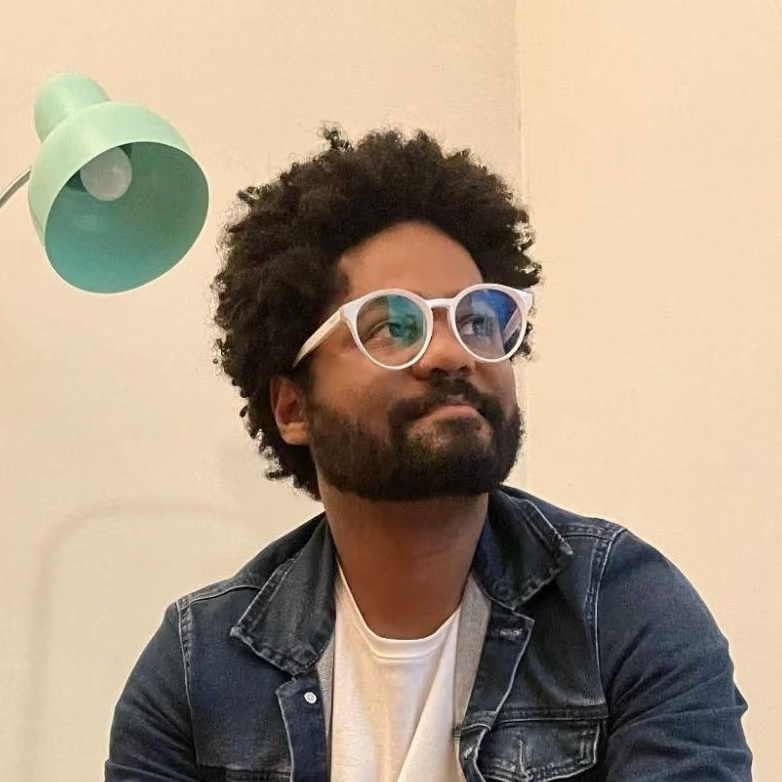
Euripedes Magalhães (Pipo) has been working in design since 1995 and active in the digital space since 1998. He began leading design teams in 2014 and today serves as a Senior Design Manager, Mentor, and Consultant. He is also a teacher and an organizer of collectives in São Paulo, where he lives. Throughout his career, he has built and led teams under the belief that hiring well is, above all, an exercise in attention, courage, and respect for people.