
The Value of People
Companies are built by people. Teams are made up of people. And products are created by people, for people. The greatest asset any company can have, throughout its entire existence, is the people who work there. When we look at a finished product — whether it's a building, a car, a t-shirt, or an app — we rarely stop to think about how many people were part of that product's story.
Early in my career, some of my college friends dreamed of working at Disney. I remember sitting with a group of them watching an animated film, and as the credits rolled, one of them said: "The day I see my name in those letters scrolling up the screen, I'll know I've made it professionally." In that moment, I noticed the staggering number of people involved in making that film. Entire teams credited for a single character. Others just for the environments. Others just for objects. More than 500 people in total. That friend went on to achieve exactly that dream: Leo Matsuda has worked at Pixar for over a decade, contributed to multiple productions, and has a short film of his own available on Disney+. Truly inspiring.
In our recruitment process at Deeploy, we treat people as what they genuinely are — the ones who will build the products of the future. That's why we focus on people, not just on open roles.
Welcome Aboard
It's natural to think of companies as tribes. Each one has its vision, mission, values, and its own way of treating people. Today, companies are increasingly being held accountable on those fronts — inclusion, diversity, accessibility — and professionals are paying attention.
For anyone who spends time on LinkedIn, it's common to see newly hired professionals sharing the news with excitement, showcasing the way they were welcomed by their new employer. Thank-you posts, photos of welcome gifts, public expressions of appreciation — all of it paints a picture of companies that genuinely value their people.
In conversations with UX/UI Designers across different levels and backgrounds, one of the top factors in their interest in a company is consistently internal culture. As a result, companies invest in creating welcoming, inclusive, and energizing environments — and it all starts with onboarding: the process of bringing a new team member in.
Based on what we've seen and the positive outcomes it produces, here are four suggestions for building a strong onboarding experience for your Design team:
1. Make the Company Vision Crystal Clear
As complex as it may be, every team member needs to be on the same page when it comes to the company's value proposition, positioning, products, and mindset. In multidisciplinary teams, gaps in this alignment are common — and they need ongoing attention.
2. Assign a Clear Owner
For onboarding to have the intended impact, someone needs to be in charge. Whether that's the UX lead or someone from HR, having a dedicated owner signals that the company takes this seriously — and that the process itself has real structure.
3. Create an Immersive Experience
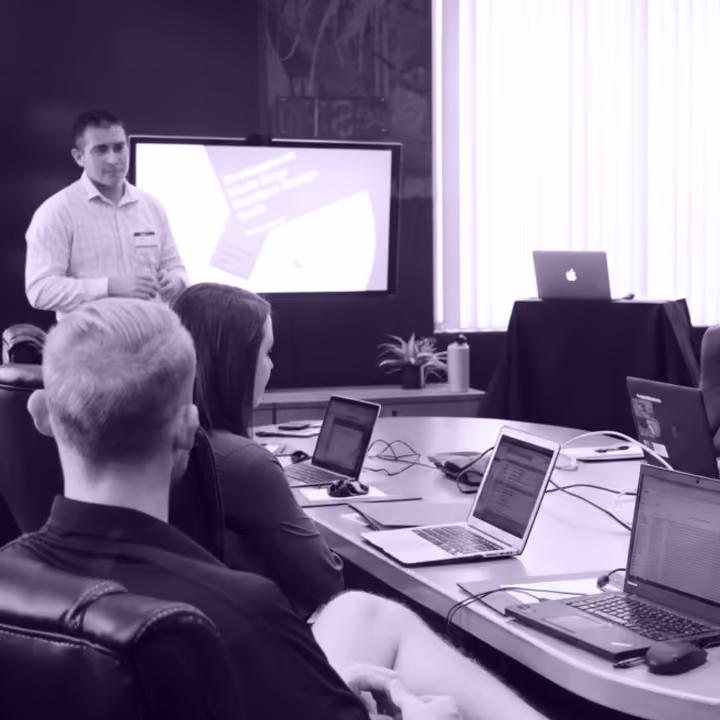
There should be a well-defined initial training process in which the new hire is formally introduced to the team. The more personal, the better. Ideally, this process should have a name, its own documentation — a guide or manual of sorts — that the new team member can refer back to, since it's a lot of information to absorb at once.
Breaking that immersion down:
Introduce the team and explain how it's organized. Even if it's a video call, clarifying who's on the Design team and what everyone does is essential for building genuine interpersonal connections. Follow that with an overview of both the vertical and horizontal structure — hierarchy, individual responsibilities, and how it all fits together.
Handle the infrastructure setup. A laptop, badge, email account, and access to shared tools need to be ready immediately, so the new hire can become productive without unnecessary friction.
Walk through the production process. Show, without ambiguity, how the work actually gets done: best practices, tools, how the team manages priorities and deadlines, how it reports to stakeholders, and how it collaborates with developers and external partners.
Introduce the brand's role. The new team member needs to understand that there's an expected standard of behavior in how the company presents itself externally. Ideally, regardless of seniority, every employee should feel a sense of responsibility for representing the brand well — which means tone of voice, writing style, communication approach, and general conduct all deserve attention and training.
4. Keep the Learning Going
Once onboarding wraps up, gathering feedback on the experience is essential. The process should be treated as something that continuously evolves — not a checkbox that gets ticked once.
But That's Just the Beginning
Onboarding is only the tip of the iceberg. The more important reality is that professionals aren't only evaluating perks — they're watching how the company actually operates. Over time, they'll notice how it's organized, the quality of leadership, and how decisions and production processes work. If those things are broken, it's only a matter of time before engagement drops, productivity fades, and people start looking elsewhere.
Conclusion
Investing in company culture is essential for retaining top talent. As valuable as benefits and perks are, the feeling of being genuinely welcomed — of belonging to something meaningful and exciting — is what actually builds a lasting relationship between companies and the people who make them work.

Mao Barros, a passionate designer with 20+ years of experience, specializes in Visual Design and No-Code. As Co-Founder and CCO of Deeploy, he helps connect UX designers to global opportunities. With a strategic, user-centric mindset, he has led design teams and collaborated hands-on with brands like Barilla, Nomad, Petlove, SoftBank, and FutureBrand.