Your professional profile is...
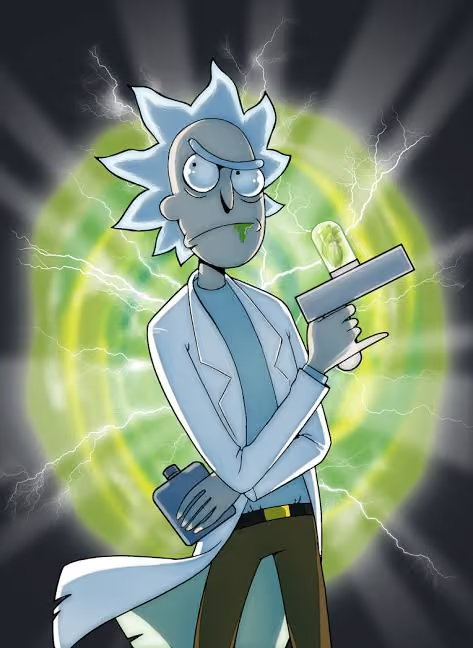
You're the one who asks the question everyone would rather not hear. While the team celebrates the approved plan, you point out the hole nobody wanted to see. It's not for fun. It's because you see the cost of autopilot. You'd rather have a rough discussion now than a dead project six months later. Your instinct is to challenge the obvious, and sometimes that bothers people. But it's exactly what keeps the team from falling into mediocre solutions.





Where you stand out
Opens new paths
When everyone goes right, you ask "what if right is wrong?" Your provocations lead to solutions nobody would have found without them.
Forces better decisions
A comfortable team produces averages. Your constructive pressure raises the standard, forcing the group to defend or rethink what they're proposing.
Prevents autopilot
"We've always done it this way" is the crack in the armor you were waiting for. You question old patterns and open space for updates in process, product, strategy.
Courage in meetings
You say what others think but don't say. That willingness to carry the discomfort of uncomfortable truths is rare and valuable on a mature team.
What needs attention
Provoking for the sake of it becomes noise
Questioning everything all the time desensitizes the team. Choosing when a provocation is worth it amplifies the impact of each one. Not every decision needs to be challenged.
Wearing out allies has a cost
Even your correct critique needs to reach people willing to hear it. Investing in the relationship before the confrontation turns provocation into conversation, instead of resistance.
Alternatives are part of the provocation
Pointing out the problem is half. Bringing a possible path, even imperfect, turns the questioning into contribution. Critique alone tires people. Critique with a proposal mobilizes them.
Timing matters
The same provocation can be brilliant in one moment and destructive in another. Reading the context (phase of the project, state of the team, risk of the decision) makes your intervention pay off.
How you work
Comfort bothers you.
When the team is in consensus, your antenna goes up. Somebody didn't think.
You don't seek a fight, but you don't avoid one when you see something important at stake.
That's why your impact is bigger in environments where there's real room to debate, not the ones that say there is and penalize those who use it.
Alternatives are part of the provocation
Pointing out the problem is half. Bringing a possible path, even imperfect, turns the questioning into contribution. Critique alone tires people. Critique with a proposal mobilizes them.
Timing matters
Timing matters
Good work, for you, is the kind nobody wanted to do but somebody needed to.
People who think like you
Different contexts, same instinct: if nobody's uncomfortable, nobody's thinking.
Where to grow
Bring an alternative along with every critique. Good provocation proposes, doesn't just point.
Critique without proposal tires the team. Critique with proposal mobilizes them.
Work close to a Creative, they give you another path while you break the current one.
Other profiles